
For decades, the standard advice for keeping an aging mind sharp was simple: do a daily crossword puzzle. However, modern cognitive science has revealed that the aging brain thrives on much more than repetitive word games. To truly build cognitive reserve—the brain’s ability to improvise and find alternate ways of getting a job done when faced with age-related damage—older adults need games that challenge multiple cognitive domains at once.
When chosen strategically, games are far more than a pastime; they are a form of non-pharmacological therapy that promotes neuroplasticity, improves executive function, and enhances quality of life.
1. Modern Strategy Board Games: The Ultimate Brain Workout
While classic games like checkers are enjoyable, modern strategy games provide a far more robust cognitive workout. These games require players to manage resources, adapt to changing conditions, and anticipate their opponents' moves.
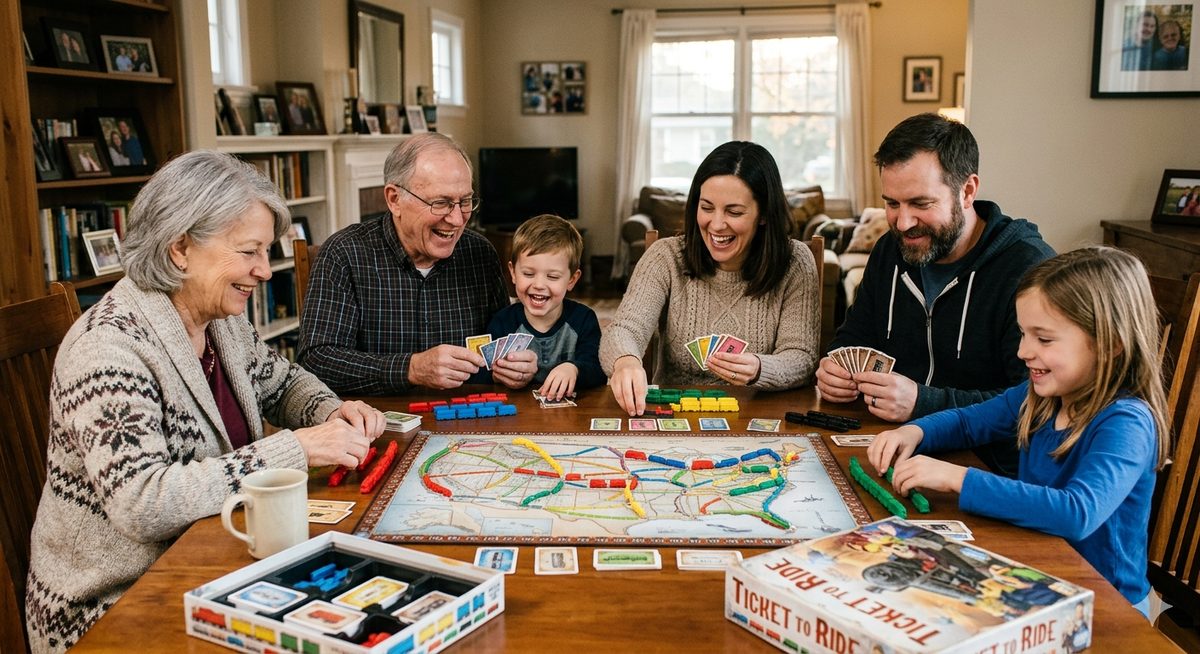
- Ticket to Ride: A game of route-building that exercises spatial planning, working memory, and long-term strategy. Players must hold their secret goals in mind while constantly adapting their tactics based on which tracks their opponents claim.
- Carcassonne: A tile-placement game where players build landscapes of medieval cities and roads. It heavily taxes visual-spatial processing and risk assessment, as players must decide whether to invest resources into existing structures or start new ones.
2. Traditional Classics with a Twist
Certain traditional games have stood the test of time because they engage the brain’s executive functions—the command center responsible for focus, decision-making, and working memory.
- Bridge: Widely considered by neuroscientists to be one of the best mental workouts available. Bridge requires players to use memory (tracking which cards have been played), strategy (bidding systems), and math. Crucially, it is a partnership game, adding a layer of social cognition and communication that help combat isolation.
- Chess and Go: These abstract strategy games force the brain to engage in "look-ahead" thinking—hypothesizing several moves into the future and evaluating the consequences. This strengthens the prefrontal cortex, the area of the brain responsible for complex planning.
3. Digitally Immersive and 3D Video Games
For a long time, video games were dismissed as a youthful hobby, but clinical research has shown that specific types of digital gaming offer massive benefits for older adults.
- 3D Platformers (e.g., Super Mario 3D World): Studies have found that training older adults on 3D platforming games actually increases the gray matter density of the hippocampus (the brain's primary memory center). Navigating a three-dimensional virtual environment forces the brain to build cognitive maps, heavily stimulating spatial memory.
- Real-Time Strategy (RTS) Games: Games like Civilization or casual management simulators require multitasking, rapid problem-solving, and cognitive flexibility (the ability to switch between different tasks smoothly).
4. Puzzles That Challenge Logic and Working Memory
To get the most cognitive benefit out of a puzzle, it needs to involve logic and pattern recognition rather than just retrieving existing trivia knowledge.
- Sudoku / Kakuro (Logic, Working Memory, Number Facility): Requires deductive reasoning and holding multiple numerical possibilities in mind at once.
- Cryptic Crosswords (Executive Function, Linguistic Flexibility): Unlike standard crosswords, cryptics require decoding wordplay and anagrams, forcing the brain out of linear thinking.
- Jigsaw Puzzles (Visuospatial Reasoning, Short-Term Memory): Finding where pieces fit requires analyzing shapes and colors while mentally rotating objects.
The Secret Formula: Novelty, Challenge, and Joy
To maximize the neurological benefits of gaming, keep three principles in mind:
- Embrace the Learning Curve: The maximum cognitive benefit happens when a player is learning how to play a game. Once a game becomes effortless, its ability to build new neural pathways plateaus. If a puzzle or game becomes easy, it is time to turn up the difficulty or switch to a new one.
- Make it Social: Playing games with friends, family, or community groups layers social interaction on top of mental stimulation. Social connection lowers cortisol (stress hormones) and is independently linked to a lower risk of dementia.
- Prioritize Enjoyment: If a game causes frustration or severe anxiety, it triggers a stress response that can negatively impact memory. The best game is one that is challenging enough to require focus, but fun enough to keep the player coming back day after day.