
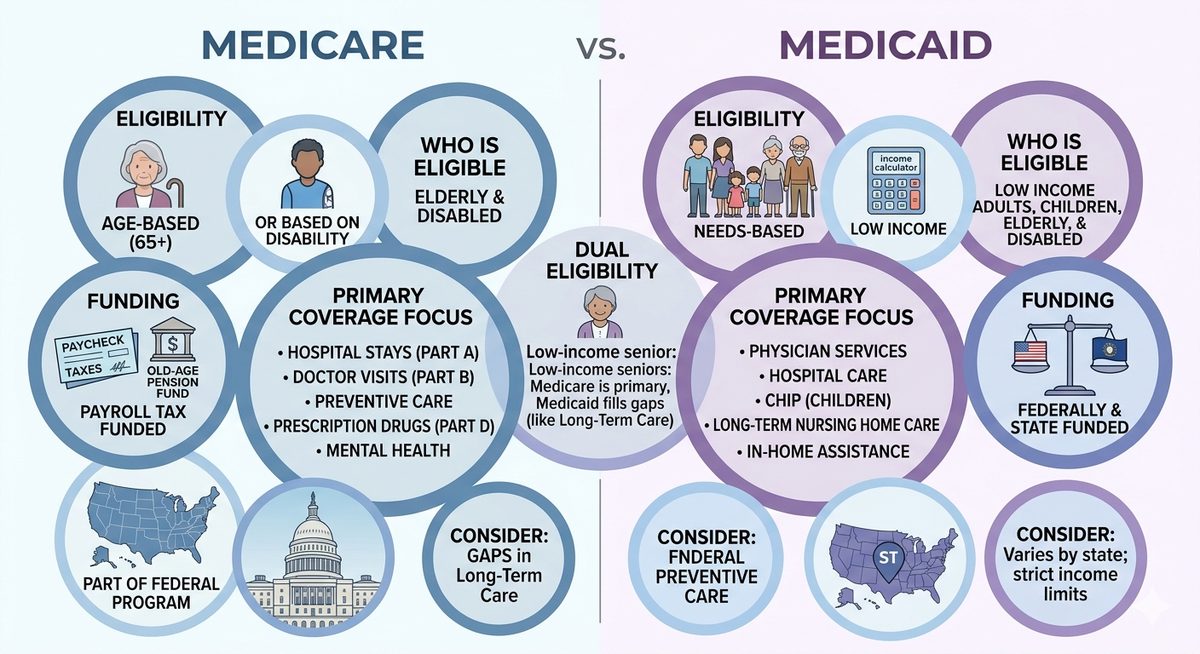
In the world of senior healthcare, "Medicare" and "Medicaid" are often spoken in the same breath, but they are as different as a mountain and a valley. While both are government-funded programs that help with medical costs, the "who," "what," and "how much" differ significantly.
Here is the breakdown of the two programs and how they often work together.
The Core Definitions
The simplest way to distinguish them is by eligibility:
- Medicare is based on age or disability. It is a federal "entitlement" program. If you have worked and paid into the system, you are generally entitled to it at age 65, regardless of how much money you have in the bank.
- Medicaid is based on financial need. It is a joint federal and state program designed for people with limited income and assets.
Side-by-Side Comparison (2026)
| Feature | Medicare | Medicaid |
|---|---|---|
| Who qualifies? | People 65+ or those with specific disabilities. | Low-income individuals, families, and seniors. |
| Primary Funding | Federal Government. | Joint State and Federal Governments. |
| Long-Term Care? | No. Only short-term rehab stays. | Yes. Long-term nursing services and some home care. |
| Out-of-Pocket Costs | Premiums, deductibles, and 20% coinsurance. | Very low or no cost for most services. |
| Administration | Uniform nationwide. | Varies significantly by state. |
The "Long-Term Care" Trap
This is the most common area of confusion for families.
- Medicare's Limit: Medicare will pay for a "Skilled Nursing Facility" only if you've had a qualifying 3-day hospital stay and need active rehabilitation (like PT after a hip replacement). Even then, it only pays 100% for the first 20 days. By day 101, Medicare pays zero.
- Medicaid's Role: Medicaid is the primary payer for long-term "custodial" care (help with bathing, eating, and dressing) in the United States. However, to qualify, you must meet your state's strict asset limits—often requiring you to have less than $2,000 in countable resources.
What Parts Do What?
Medicare is divided into "Parts," whereas Medicaid is a comprehensive package.
- Medicare Part A: Hospital insurance (inpatient stays).
- Medicare Part B: Medical insurance (doctor visits, outpatient tests).
- Medicare Part D: Prescription drug coverage.
- Medicare Part C (Advantage): Private plans that bundle the above and sometimes add dental or vision.
Can You Have Both? ("Dual Eligibility")
Yes! Approximately 12 million Americans are "Dual Eligible." In this scenario:
- Medicare is the "Primary Payer": It pays for your doctor visits and hospital stays first.
- Medicaid is the "Safety Net": It steps in to pay for what Medicare leaves behind, such as your Part B premiums, deductibles, and long-term care costs.
The "Spend Down" Phenomenon
Many seniors who start as "Private Pay" in a nursing home eventually run out of money. Once their assets hit the state-mandated threshold, they "spend down" to Medicaid eligibility. This is why it is vital to ask if an assisted living or nursing facility is "Medicaid Certified" or will accept a Medicaid spend down before moving in—otherwise, you may be forced to move if you run out of funds.
Note for 2026: Be aware that some states are introducing new work requirements or residency recertification rules for Medicaid. Always check your specific state's portal for the most current eligibility math.