
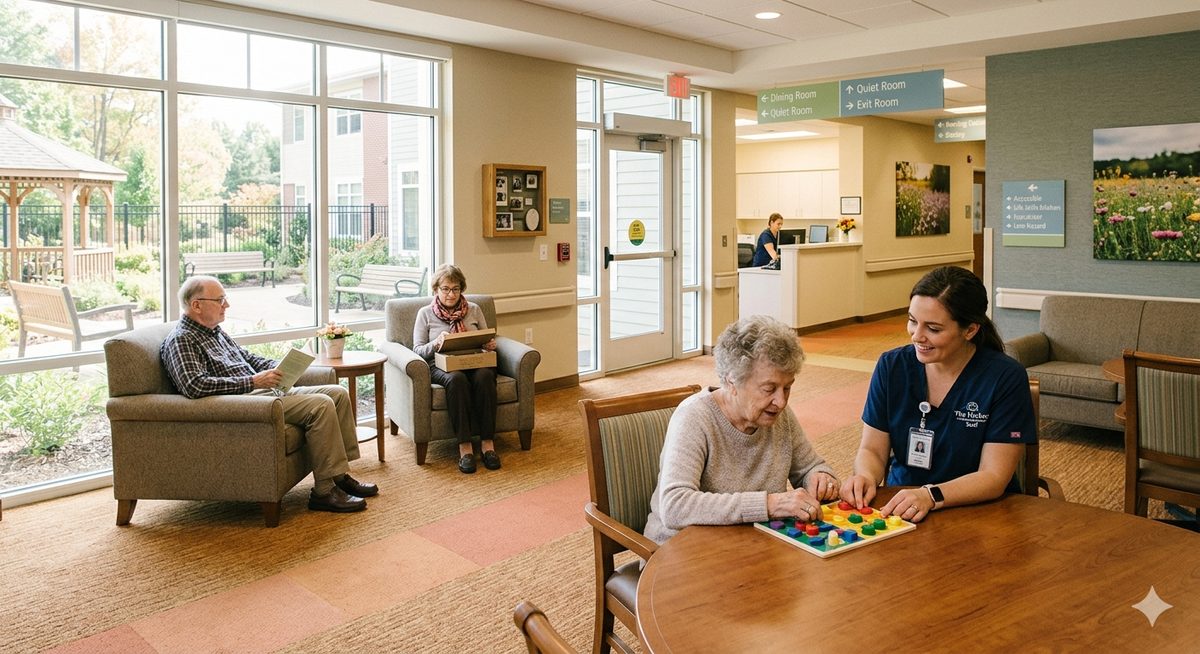
When a loved one is diagnosed with a progressive neurodegenerative disease like Alzheimer's or another form of dementia, families eventually reach a crossroads. As the condition advances, the cognitive challenges can outgrow the safety and resources of a standard home or traditional assisted living environment.
This is where secure memory care comes in. Far from just a separate wing in a senior living facility, secure memory care is a highly specialized, deeply intentional environment designed from the ground up to protect, support, and engage individuals experiencing significant cognitive decline.
The Defining Feature: Purposeful Security
The most immediate distinction of a secure memory care community is its controlled environment, engineered to address one of the most common behaviors associated with advanced dementia: wandering.
Due to disorientation, spatial confusion, or a phenomenon known as "sundowning" (increased confusion and restlessness in the late afternoon), individuals with dementia may attempt to "go home," look for a long-past job, or simply walk without a destination. In a standard neighborhood or unsecured building, this poses a life-threatening risk.
Secure memory care features discrete safety measures:
- Keypad-Controlled Entry and Exit: Doors leading outside require a code or a specialized staff badge to open. This prevents residents from wandering into dangerous areas, such as parking lots or busy streets.
- Camouflaged Exits: To prevent frustration or a feeling of being locked in, exit doors are often visually blended into the surrounding decor, painted to look like regular walls, covered with beautiful murals, or hidden behind curtains.
- Enclosed Outdoor Courtyards: Residents can still enjoy fresh air, gardening, and walking paths, but the outdoor spaces are entirely enclosed by secure, high-quality fencing masked by landscaping.
Architecture and Design Rooted in Science
Every physical aspect of a secure memory care unit is designed to reduce anxiety and navigate the sensory changes that accompany cognitive decline:
- Circular Floor Plans: Hallways often loop continuously rather than ending in dead ends. If a resident feels the urge to walk, a circular path allows them to move freely without hitting a frustrating physical barrier that might trigger anger or confusion.
- High-Contrast Environments: Dementia affects visual-spatial perception. Facilities utilize high-contrast colors, such as a dark toilet seat against a light wall, to help residents identify fixtures independently and prevent falls.
- Reduced Sensory Overload: Loud alarms, intercoms, and chaotic visual patterns are minimized to prevent agitation, hallucinations, or catastrophic reactions.
Specialized Staffing and Therapies
In standard senior living, staff are primarily trained to assist with physical activities of daily living (ADLs), like bathing or dressing. In secure memory care, the staff undergo rigorous, continuous training in dementia care communication and behavioral management.
Because residents may lose the ability to speak clearly, staff are trained to look past behaviors (like pacing or shouting) to find the underlying unmet need, whether it is pain, hunger, boredom, or the need to use the restroom.
Furthermore, life inside memory care centers around specialized, failure-free therapies:
- Reminiscence Therapy — Utilizing old photographs, vintage music, and familiar items from the 1950s–1980s. The goal is to tap into intact long-term memories to breed comfort and a sense of identity.
- Validation Therapy — Instead of correcting a resident who believes they need to pick up their young children, staff validate the emotion behind it ("You love your kids so much, tell me about them"). This eliminates the anxiety and combativeness caused by forced reality-orientation.
- Structured Routine — Keeping a highly predictable schedule for meals, waking, and activities minimizes the anxiety of not knowing what comes next in an unpredictable world.
Embracing Autonomy Within Boundaries
A common misconception is that secure memory care mimics a cold, clinical psychiatric ward. In reality, modern memory care philosophy embraces "autonomy within boundaries."
By creating a completely safe perimeter, the facility actually allows residents more freedom than they might have at home. Inside the secure zone, they can wander safely, choose where to sit, participate in structured activities, and socialize without a caregiver constantly needing to say "no" or "don't go there" for their own safety.
Is It Time for Memory Care?
Transitioning a loved one to secure memory care is often a painful emotional decision for families, frequently accompanied by misplaced guilt. However, when a senior's safety is compromised, whether through wandering, forgetting to eat, accidental self-harm, or when the physical and emotional toll on the family caregiver becomes unsustainable, secure memory care is not an act of giving up. It is a transition to a lifestyle where they can live with maximum dignity, surrounded by people who speak the unique language of dementia.
Please note that for many memory care communities within Washington and Oregon state, a potential resident must have a formal diagnosis of dementia or Alzheimer's to be eligible for moving in.